
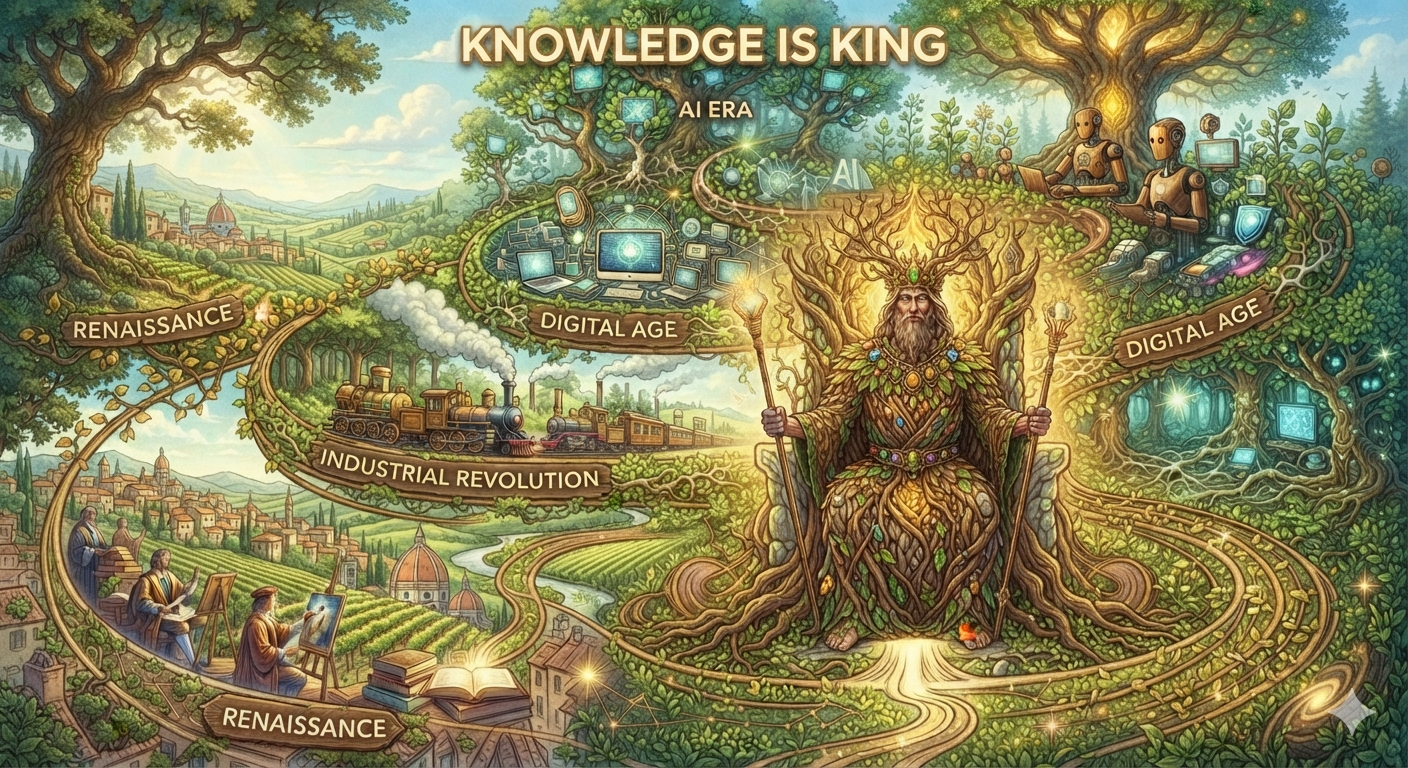
Knowledge Is King
9/9/2026
Every consequential era in human history has run on the same fuel: knowledge that made the leap from scattered noise to organized, scrutinized, categorized substance.
The Renaissance had books. Movable type took knowledge locked in monasteries and scribes' hands and turned it into something reproducible — the first time an idea could outrun the person who had it. The Industrial Revolution had manuals and diagrams. A blacksmith's tacit skill became a schematic anyone could follow, and suddenly factories could scale a craft that used to take a lifetime to learn. The digital age had the internet — the noisiest knowledge event in history, billions of fragments dumped into one commons, slowly indexed, linked, and searchable.
Each transition followed the same arc: noise → curation → structure → leverage. The civilizations, companies, and individuals who got there first didn't necessarily have more knowledge than everyone else. They had organized knowledge before everyone else did. That gap was the advantage.
We're in the middle of it again
Today's version of that arc is unfolding through AI. Large language models, vector databases, and wikis are the printing press, the manual, and the internet index of this moment — mechanisms for taking raw, chaotic knowledge and making it structured, retrievable, and actionable at a scale no previous era could touch.
But there's a difference this time that should give us pause: the raw material — humanity's collective knowledge — was built commonly, over centuries, by everyone. Yet the organized version of it is increasingly fenced off, metered, and sold back to us at a premium. The tools that do the organizing (frontier models, curated datasets, high-quality embeddings) are trending toward scarcity pricing, not abundance pricing.
That's the part of the pattern that's breaking.
Commodities
Wheat and rice are commodities because they are essential, fungible, and — critically — treated as something the world has a collective interest in keeping accessible. Nobody thinks it's acceptable for basic caloric knowledge (how to grow food) to be locked behind a paywall. We built entire agricultural extension systems, land-grant universities, and international aid programs on the premise that this kind of knowledge should flow freely, because everyone benefits when it does.
Structured knowledge — the organized, scrutinized, categorized kind that AI now runs on — has the same characteristics. It's non-rivalrous (my using it doesn't stop you from using it). It compounds when shared (more eyes and more use cases make it better, not worse). And it is now, arguably, as essential to participating in the modern economy as wheat is to eating.
If knowledge really is king — the resource that has quietly powered every leap in human progress — then treating its highest, most refined form as a luxury commodity is a strategic error, not just a moral one. Wheat shortages cause famines. Knowledge shortages cause a different kind of famine: entire populations, companies, and countries locked out of the tools that determine who builds the next era and who merely lives through it.
What "priced like wheat" could actually mean
This isn't an argument that nothing about knowledge infrastructure should be monetized — compute, curation labor, and engineering all cost real money, and someone has to pay for the mill even in a world where grain is cheap. It's an argument about the target: the baseline layer of organized knowledge should be priced for access at scale, the way commodity staples are, with margin captured further up the value chain (specialization, service, speed) rather than at the gate.
Concretely, that looks like:
- Open, canonical knowledge bases that anyone can query, the way public libraries and land-grant extension services did for print and agriculture.
- Community-curated and scrutinized sources — wikis, peer-reviewed commons, shared vector stores — treated as public infrastructure, not proprietary moats.
- Commodity pricing for baseline access, with premium pricing reserved for the refinement layer: bespoke models, specialized agents, service and support — not for the raw ability to ask a question and get a sourced answer.
The stakes
Every prior knowledge revolution eventually democratized — books got cheap, manuals got public, the internet (mostly) stayed open. The gap between "who has organized knowledge first" and "who has it at all" closed over time, and that closing is what let each era's progress become broad progress instead of a permanent advantage for whoever got there first.
AI is at the stage where that gap is widest and the incentive to keep it wide is strongest. Whether it closes — whether structured knowledge becomes as available as wheat and rice — will probably determine whether this era's progress is shared the way the printing press's eventually was, or hoarded the way scribal manuscripts once were, before books made that hoarding pointless.
Knowledge is king. The question worth asking isn't whether that's true — it's who gets to eat.